The Basics
Cancer is not a single disease, but a collection of related diseases that can occur any parts of the body. At the fundamental level, it is the disease of the Genes. It is a common understanding that cell die and cell divide. These are controlled by genes. Generally there are two kinds of genes: one that suppress cell division called Tumor suppressor genes and another that enhance cell division called oncogene. When there is imbalance in these genes, cells deviate from normal cell division, causing them to grow and divide when they should not—or preventing them from dying when they should. This results in cell tumor formation. These abnormal cells can become cancer. Most cancers form solid tumors, which are masses of tissue.
Normal cells versus Cancer cells
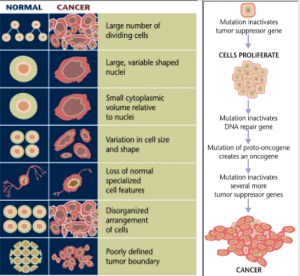
(image: universe-review.ca)
Normal cells
• Reproduce themselves only when and where they are needed
• Stick together in the right place in the body
• Self destruct if they are damaged or too old
• Become specialised (mature)
Cancer cells
• Don’t stop growing and dividing
• Ignore signals from other cells
• Don’t stick together
• Don’t specialize
• Don’t repair themselves or die
• Look different
(Source:Cancer Research UK)
Origin of Cancer
At the Molecular level, there is no precise answer to the origin of Cancer. Researchers have sharp knowledge after its origin when Cancer arise. Cancer is a disease of a gene. Each cancer cell has a unique combination of genetic changes. As the cancer continues to grow, additional changes will occur. These changes drive several factors that support cancer growth and make them favorable. Overall, the cancer cell has different Metabolic activities, several mutations, acidic pH, cell cycle pattern etc.
Drivers of Cancer
Although there are several changes in cancer cell, these changes are brought about by three major genetic changes in Cancer cells. These changes drive the cancer cells. The genes responsible for driving the Cancer cells include:
Certain mutations in these genes render them non-functional and hence deviate from the normal course causing mutations in DNA, which ultimately cause cancer.
Types of Cancer
There are more than 100 types of cancer. Each named with the organ affected. Here is the A-Z list of cancer type.
Cancer Statistics
According to WHO report–
- Cancer is one of the leading cause of morbidity and mortality worldwide, with approximately 14 million new cases and 8.2 million cancer related deaths in 2012.
- The number of new cases is expected to rise by about 70% over the next 2 decades.
- Among men, the 5 most common sites of cancer diagnosed in 2012 were lung, prostate, colorectum, stomach, and liver cancer.
- Among women the 5 most common sites diagnosed were breast, colorectum, lung, cervix, and stomach cancer.